
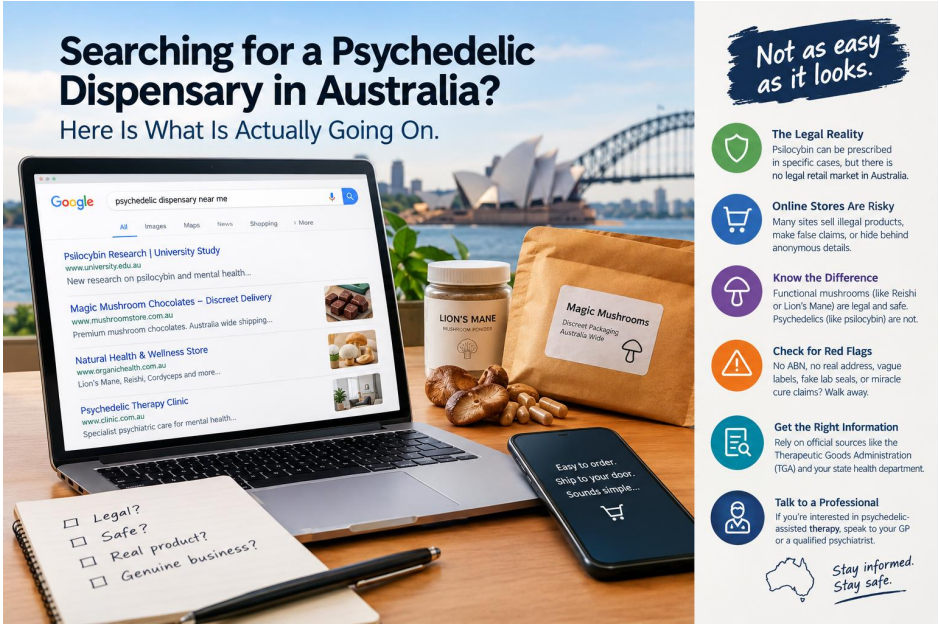
I spent a few hours looking into what pops up when you search for a “psychedelic dispensary near me” from down under, and honestly, the search results are a wild west. You type it in expecting a clear clinic directory or local health resource, but instead, Google dumps a bizarre mix of stuff onto your screen. You’ll see university research papers sitting right alongside glossy online shops offering to ship “magic mushroom chocolates” straight to your front door in plain brown padded envelopes. It looks so easy. Almost like ordering a pair of shoes or a takeaway meal online on a Friday night.
Except it isn’t. Not even close.
A clean, modern website with minimalist fonts and a little padlock icon in the URL bar doesn’t mean a business is operating legally in Australia. In fact, most of the time, it’s quite the opposite. When news broke worldwide that Australia became the first country to reclassify psilocybin for psychiatric use, a lot of people naturally assumed the floodgates had opened. People thought, “Right, so it’s legal now.” Well, yes and no—but mostly no, at least not in the way these slick online storefronts want you to believe.
The phrase “psychedelic dispensary” itself is a massive trap in Australia right now because search engines lump completely different things into the exact same bucket. You’ll see accredited psychiatric clinics right next to local health food shops selling non-psychoactive Lion’s Mane powder, mixed in with non-profit advocacy groups and plain old gray-market vendors shipping illicit products. Buying a jar of Reishi or Cordyceps powder from your local organic market to mix into a morning smoothie is totally fine and legal. But a random website promising discreet mail-order magic mushrooms? That’s an entirely different legal situation under Australian federal law. You really can’t let vague marketing buzzwords like “plant medicine” or “psychedelic wellness” fool you. You have to look past the branding and check what active compounds are actually listed—assuming they even bother listing them at all.
Let’s get real about the legal situation for a second. The Therapeutic Goods Administration did reclassify psilocybin so it could be prescribed for treatment-resistant depression. That part is 100% true. But the fine print is massive, and most people skip right over it. You cannot simply log onto a website and buy psilocybin. Period. Access is locked tight behind authorized specialist psychiatrists operating inside heavily audited medical frameworks. There is zero commercial retail market for psilocybin in Australia. So if a vendor tells you it’s completely legal to buy magic mushrooms for home use or self-guided therapy, they are lying to make a sale. State laws also carry heavy criminal penalties for possession, importation, and supply. If you’re ever unsure, ignore the vendor’s internal FAQ page and look directly at official TGA guidance.
If you do happen to land on one of these online shop pages, ignore the glowing testimonials on their homepage and look for the actual red flags. Are they ghost operators with no physical address, no registered business number, and only a Telegram handle or generic contact form? That’s an immediate reason to walk away. Are they making miracle health claims, promising their product cures clinical depression overnight, or telling you to ditch your prescribed meds? Real medicine doesn’t work like that. Be careful with mystery ingredients too—labels using vague phrases like “proprietary mushroom blend” without specifying exact species or milligram dosages mean you have no idea what you’re putting into your body. And don’t be fooled by fake lab seals either. Slapping a generic “100% Lab Tested” graphic in the website footer costs nothing. Unless they provide a real, verifiable Certificate of Analysis tied to an actual batch number, it’s pure window dressing.
This brings up a point that trips up so many people: functional mushrooms versus psychedelics. They are not the same thing. Functional mushrooms—like Chaga, Turkey Tail, or Reishi—are non-psychoactive, legal dietary supplements sold everywhere. They won’t make you trip, and they contain zero psilocybin. The problem is that shady online sellers intentionally blur these lines. They’ll use trippy, psychedelic imagery on legal mushroom products to tease buyers, or they’ll do the exact opposite to sneak past credit card processors. Always check the scientific Latin names on the ingredient list so you actually know what you’re paying for.
And whatever you do, don’t rely on customer reviews to judge safety. It’s easy to read fifty 5-star reviews on a site and think, “Okay, cool, other people are buying this so it must be safe.” Online reviews are ridiculously easy to fake, buy, or edit. Even when a review is completely real, all it proves is that a package showed up in the mail on time. An everyday reviewer can’t verify if a product is chemically pure, accurately dosed, or legal under Australian law.
I know people usually have a bunch of quick questions when trying to navigate this stuff, so let’s address them directly.
First off, what should you actually look for if you stumble onto one of these online “dispensary” sites? The answer is simple: check for verifiable business details, an active ABN, physical contact info, and realistic legal explanations. If the owners are completely anonymous or making sweeping medical claims, treat it as a huge red flag.
Are online dispensaries legal anywhere in Australia? The short answer is no. Australia has no legal retail market for purchasing psychedelics over the internet. The only legal pathway is through specialized medical doctors in authorized clinical settings for specific mental health conditions.
Is buying psilocybin online okay if you intend to use it purely for personal therapeutic reasons? Unfortunately, no. Personal or recreational purchases of psilocybin online remain strictly illegal under both federal and state legislation, regardless of how you plan to use it.
Are functional mushroom supplements the same as magic mushrooms? They aren’t at all. Functional mushrooms like Lion’s Mane or Reishi are completely legal, non-psychoactive wellness supplements containing zero psilocybin.
Where can you find legitimate legal information? Skip commercial blogs and vendor websites entirely. Go straight to primary government sources like the Therapeutic Goods Administration website or your state’s health department portal.
At the end of the day, take everything you read on commercial dispensary websites with a massive grain of salt. If you’re genuinely interested in psychedelic-assisted therapy for your mental health, skip the online storefronts and talk to your GP or a qualified psychiatrist who knows your personal medical history. Don’t risk your health, your money, or your legal standing on an anonymous website.