
I was looking into what vendors down under are actually pushing when people try to weigh up mushroom gummies against plain old dried mushrooms. Honestly, the whole market is a complete circus of clever marketing spin.
On one side, you’ve got these bright, fruit-flavoured gummies packaged up like lollies from a local corner shop. On the other side, you’ve got little plastic baggies full of shrivelled, earthy-looking dried fungi that look like someone dug them out of a wet patch in the bush. Put them next to each other, and it’s pretty easy to see why people make assumptions. You automatically guess the gummy is just the modern, neat version—a sweet little alternative that saves you from chewing through gritty, bitter dried stems.
Turns out, that whole train of thought falls apart the second you flip the jar around and actually read the fine print.
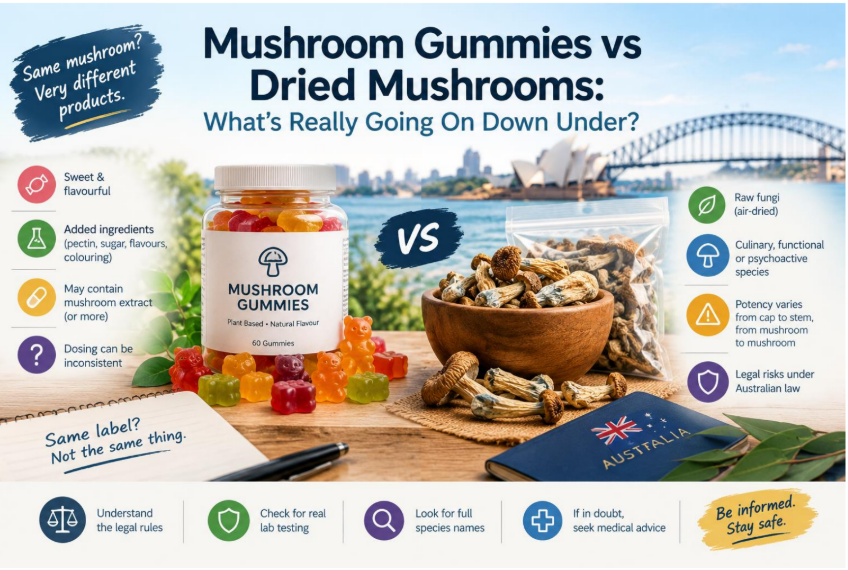
Comparing a gummy to a dried mushroom isn’t like comparing a fresh apple to a dried fruit snack. You’re usually looking at two totally different product classes. They’re made differently, they hit your system differently, and under Australian federal law, they carry completely different legal baggage.
The biggest mistake folks make is assuming everything with a mushroom drawn on the front label starts from the exact same raw material. Dried mushrooms are fairly simple physically. They’re raw fungi with the moisture baked or air-dried out of them so they don’t rot. But even then, you’ve got three totally separate camps. You’ve got culinary ones you slice into a pasta sauce like shiitake, functional non-psychoactive stuff like Lion’s Mane or Reishi, and then actual psychoactive species containing psilocybin. Drying removes the water weight—which concentrates the overall mass—but it doesn’t change the underlying chemistry of the species.
Gummies? That’s manufactured confectionery. You’re eating gelatin or pectin, glucose syrup, artificial flavourings, food colouring, and citric acid, mixed in with whatever mushroom extract or powder the manufacturer decided to dump into the vat. Sometimes it’s a legit hot-water extract. Other times—especially with sketchy online brands— it’s cheap raw powder or synthetic research chemicals hiding behind a “proprietary blend” sticker. So when you pop a gummy, you aren’t just eating a mushroom. You’re eating a piece of candy where the actual fungal ingredient might make up less than five percent of the whole bite.
Then there’s this massive myth about dosing precision. People constantly tell me that gummies are pre-dosed, so every piece is exact. In theory, sure, if a product is made in a pharmaceutical-grade, heavily audited facility with proper lab testing, every gummy should be identical. But in the unregulated or gray-market space? Forget about it. If the factory worker didn’t mix the batch properly before pouring it into the silicone moulds, one gummy might have almost zero active ingredients while the one sitting right next to it in the same tub packs three times the intended dose.
With raw dried mushrooms, potency naturally fluctuates from cap to stem, from mushroom to mushroom, and from flush to flush. Growing conditions, light, soil nutrients, and age all change the compound concentration. Two dried stems that weigh the exact same on a digital pocket scale can easily have different strength levels. So yeah, raw shrooms are variable by nature—but assuming a gummy is perfectly consistent just because it’s shaped like a uniform gummy bear is a dangerous gamble.
Also, don’t buy into the idea that gummies give you a milder experience just because they taste like strawberries. Your liver doesn’t care if an active compound arrived wrapped in sugar jelly or swallowed whole as a dry stalk. Once digested, the molecules hit your bloodstream all the same. Functional mushrooms like Lion’s Mane won’t make you trip regardless of the form. And if a gummy actually contains psilocybin or synthetic analogs, it will cause mind-altering effects just as intensely as raw dried fungi—sometimes even faster if the pectin dissolves quickly in your stomach acids.
Safety-wise, both options fail in totally different ways. With dried mushrooms, the big hazard—aside from strict Australian drug laws—is misidentification and bad storage. Eat a wild toxic species by mistake, and you’re looking at severe poisoning. Store them in a damp drawer, and you’ll be choking down toxic mold. With gummies, the real danger is label opacity. Shady brands love hiding behind vague terms like “psychedelic wellness complex.” Independent laboratory tests on unregulated gummies bought online have repeatedly turned up synthetic research chemicals, heavy metals, and prescription drug residues that have zero business being near a mushroom product. Plus, let’s be real—they look like candy, making them a massive risk for accidental ingestion by kids or pets if left lying on a kitchen bench.
Legally speaking down under, the rules are pretty clear despite what vendor websites claim. Under TGA guidelines, psilocybin is a strictly controlled schedule 8 compound. Australia did open up a pathway allowing authorized specialist psychiatrists to prescribe psilocybin for treatment-resistant depression, but that is a heavily audited, clinical-only process. It didn’t create a legal commercial market. You cannot legally buy psilocybin gummies or dried magic mushrooms online, over Instagram, or from a store in Australia for personal or recreational use. Functional mushroom gummies—like pure Lion’s Mane or Reishi—are legal as dietary supplements, provided they don’t make unproven therapeutic disease claims. But if an online store claims to ship “legal psychedelic gummies” to your Aussie address, you’re either looking at an outright scam, an illegal operation, or a tub full of synthetic chemicals.
People often ask me whether mushroom gummies are actually safer than dried mushrooms. The honest answer is not necessarily. A legitimate Lion’s Mane gummy from a chemist is safe, but an unregulated “psychedelic” gummy bought off an anonymous website carries massive risks of fake labelling, heavy metals, or synthetic additives. Safety comes down to manufacturing transparency and real lab reports, not whether a product is chewable.
Another question that comes up a lot is why some people say gummies take longer to kick in. It mostly comes down to stomach contents and digestion speed. Gummies made with gelatin or heavy sugar syrups take a bit of work for your digestive enzymes to break down alongside food. Mind you, raw dried mushroom cell walls made of chitin are also notoriously tough on the gut and often cause stomach cramps or delayed processing. Neither format gives you an exact timer.
I also get asked if you can accurately measure doses with dried mushrooms using a digital scale. Only roughly. Weighing dried mushrooms gives you physical mass, but it doesn’t reveal the milligram concentration of active compounds inside that specific cap or stem. Natural biological variation means weight is just a ballpark estimate, not a chemical guarantee.
Finally, folks ask what to do if someone has a bad reaction or eats an unknown mushroom product. If anyone shows signs of distress, severe confusion, or illness after taking an unknown gummy or dried mushroom, get medical help straight away. In Australia, call 000 for emergency services, or call the Poisons Information Centre on 13 11 26 for urgent, 24/7 expert advice.
At the end of the day, when you’re looking at mushroom gummies versus dried mushrooms, stop judging them by their appearance. A sweet gummy isn’t automatically safer or gentler, and a dried mushroom isn’t automatically reliable just because it looks natural. Look for full species names, insist on third-party batch testing sheets, and always check official Australian regulations before spending your money.